RCM Špedicija d.o.o.
Open the conceptA concept for a Zagreb freight forwarder: procedure 42 and the route of the goods up front, a route map and a customs checklist that becomes an enquiry.
RCM Špedicija d.o.o. is not my client and did not commission this website. I made the concept on my own initiative from the text and photos on their public website, so every fact on it is theirs.
- Page weight
- 4.63 MB → 0.35 MB
- Requests on load
- 82 → 17
- Fits a phone
- No → Yes
- Main content on a phone
- 22.0 s → 2.3 s
Measured in Chrome on 14 November 2026: phone, throttled 4G and CPU, no cache, median of three runs. Current website first, concept second.
- Company
- RCM Špedicija d.o.o.
- Service
- Concept website, route map and customs checklist
RCM Špedicija d.o.o. works from the Jankomir freight terminal in Zagreb: customs paperwork for imports, exports and transit, transport and a customs warehouse. Through its Slovenian sister company, RCM d.o.o., it also clears Croatian importers' goods in Slovenia under procedure 42. Customers arrive with two questions: what do I need to clear customs, and where is it better to clear.
What I found
I went through spedicija.hr on 14 November 2026, on a laptop and on a phone.
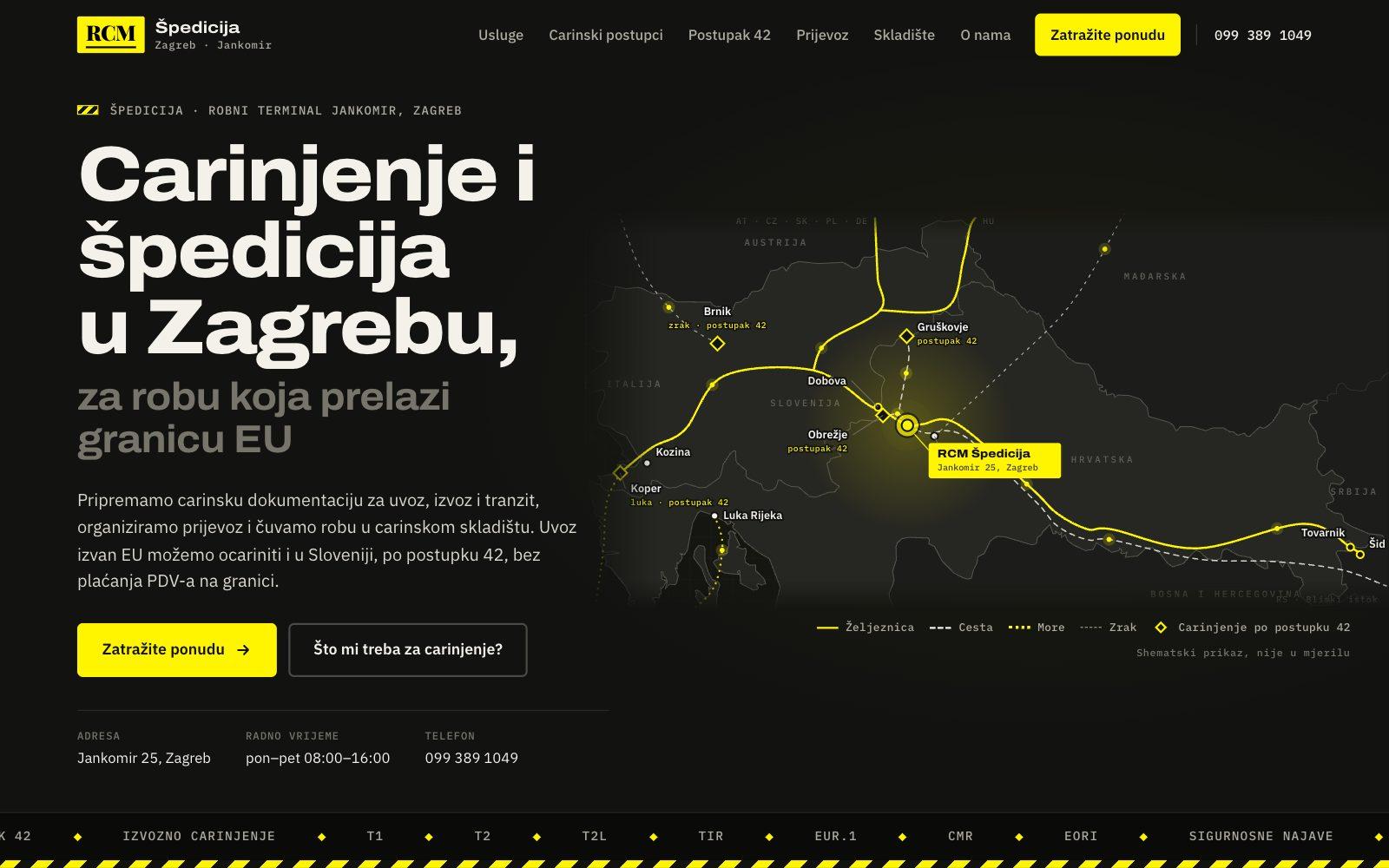
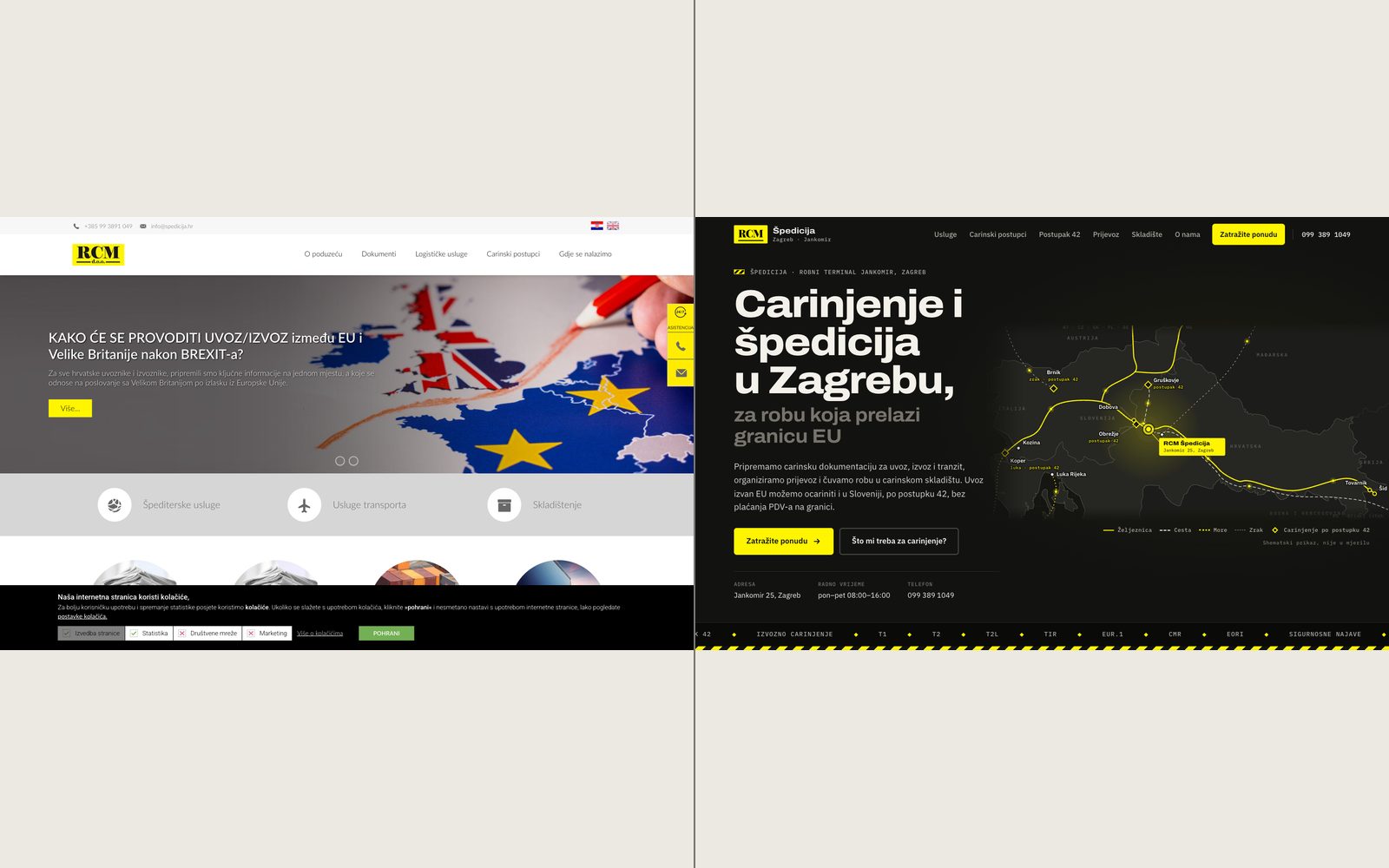
- The first screen is a slider. The first slide asks how trade with the United Kingdom will work after Brexit; the second talks about complete logistics solutions. On a laptop, a cookie bar covers the bottom.
- With no mobile viewport tag, a phone shows the page 980 px wide, shrunk to about 40 %.
- On the home page, procedure 42 gets one sentence. That the 25 % import VAT is not paid at import only appears on its own page.
- What importer, forwarder and carrier must prepare is well described, but spread over three pages.
- The contact form asks for name, company, town, email, phone and "Interests", but not what the goods are or which procedure is needed.
Decisions
The EU border on the first screen
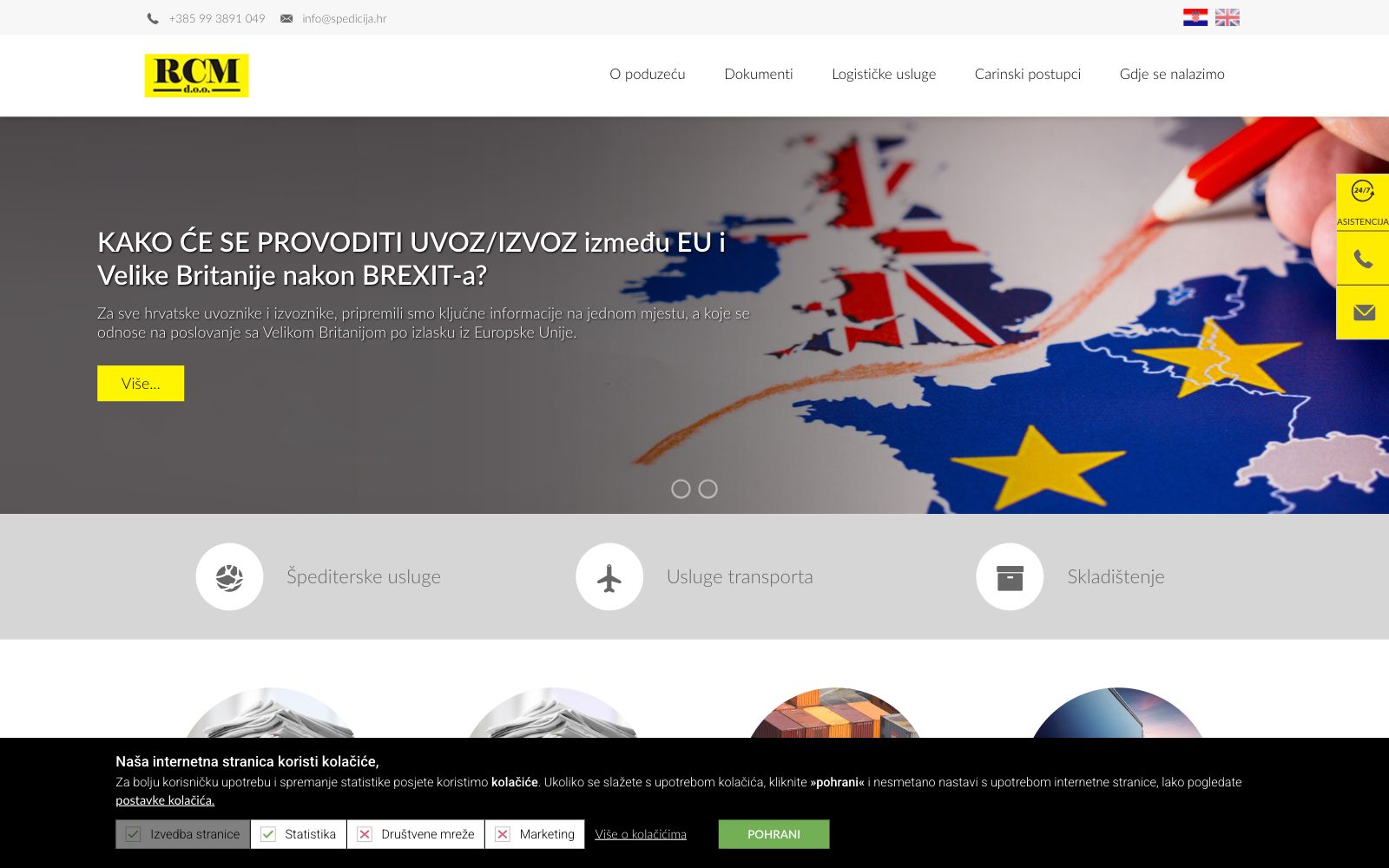
The headline says it plainly: customs clearance and forwarding in Zagreb, for goods crossing the EU border. Beside it, a map draws itself once with the routes from their site: the Šid to Dobova rail line, rail from the Port of Koper, the ports, the airports and the four procedure 42 clearance points. It is labelled as an illustration, and on a computer its layers shift slightly with the pointer.
Procedure 42 as the route of the goods
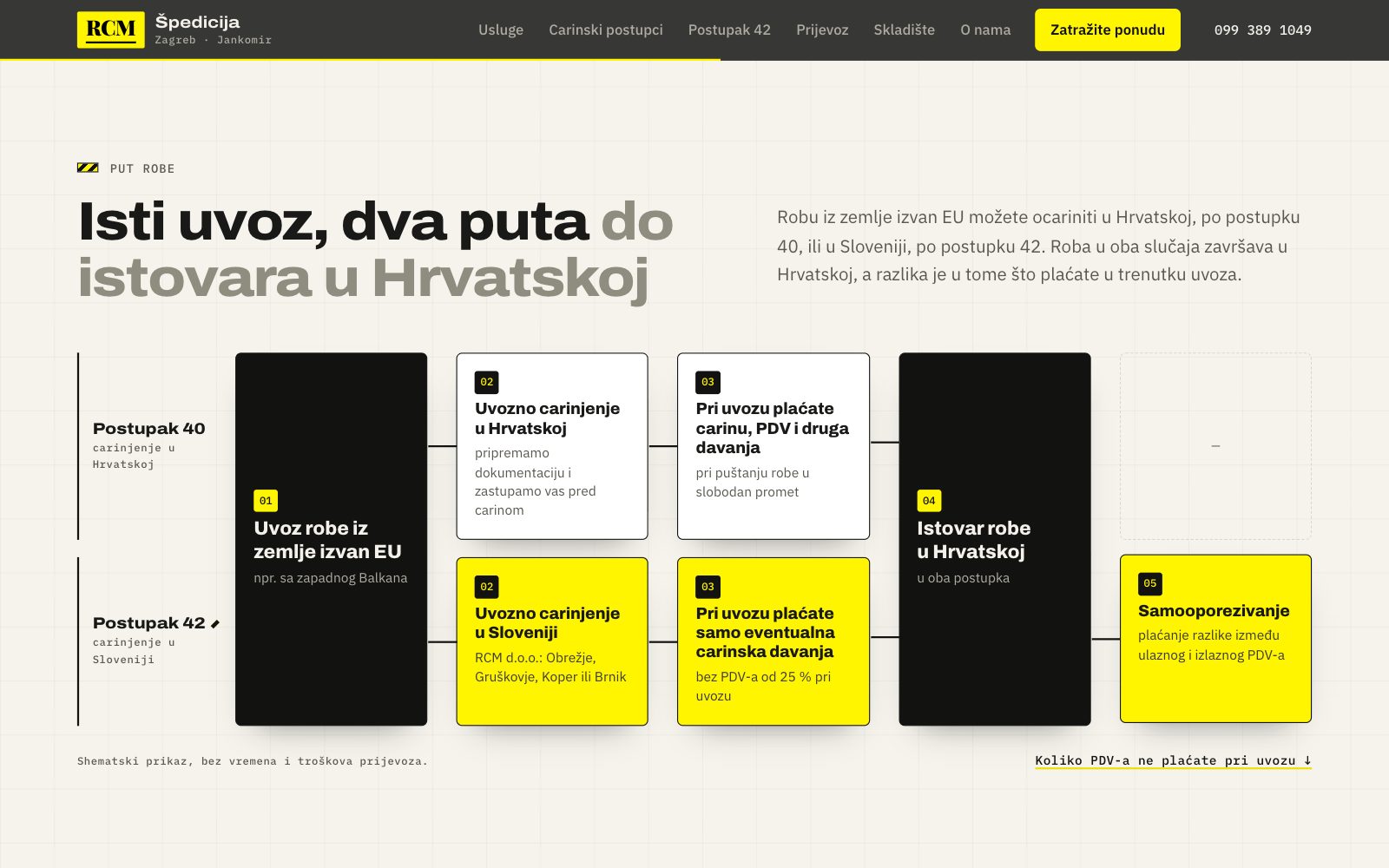
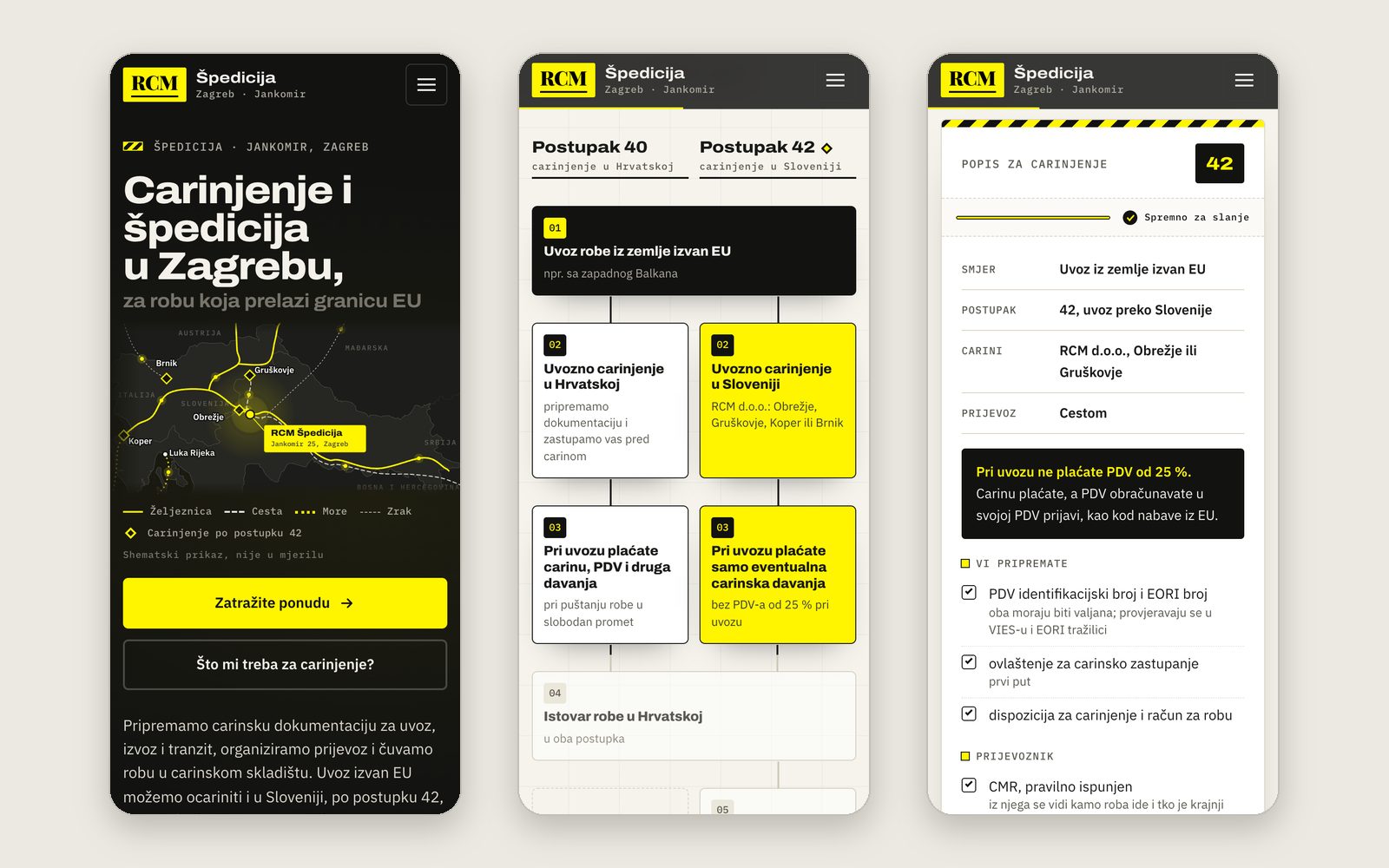
Their strongest argument is the money an importer keeps at import, so I brought it forward. Their procedure 42 page describes two routes for the same goods, clearance in Croatia and in Slovenia. I turned that into a section that holds still while the visitor scrolls: both routes start from the same non-EU goods, split at clearance and payment, meet at unloading in Croatia, and procedure 42 ends with VAT self-assessment.
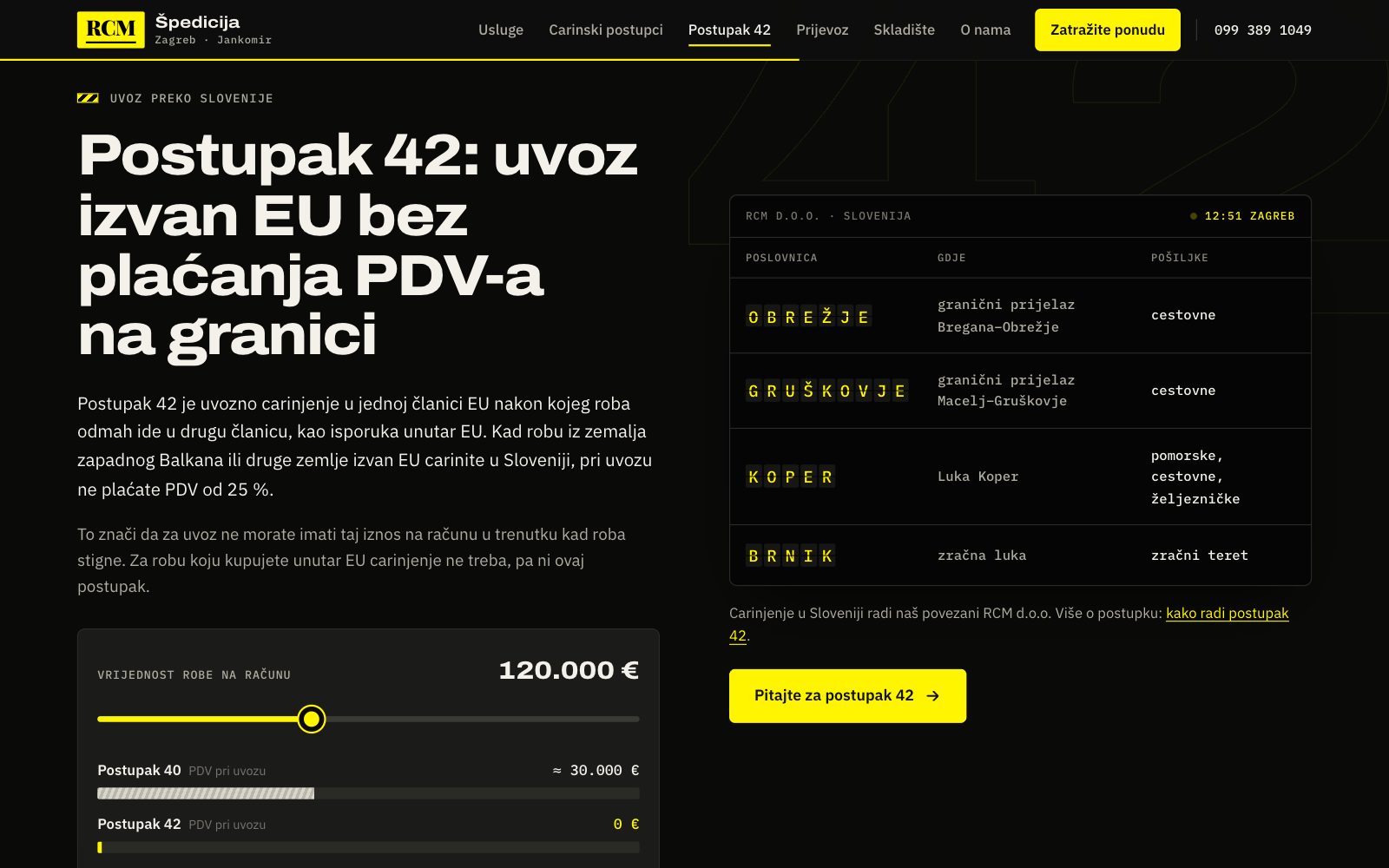
Below it, a slider for the value of the goods shows roughly what 25 % import VAT comes to under each procedure, next to a board of the four Slovenian branches.
A customs checklist instead of a form
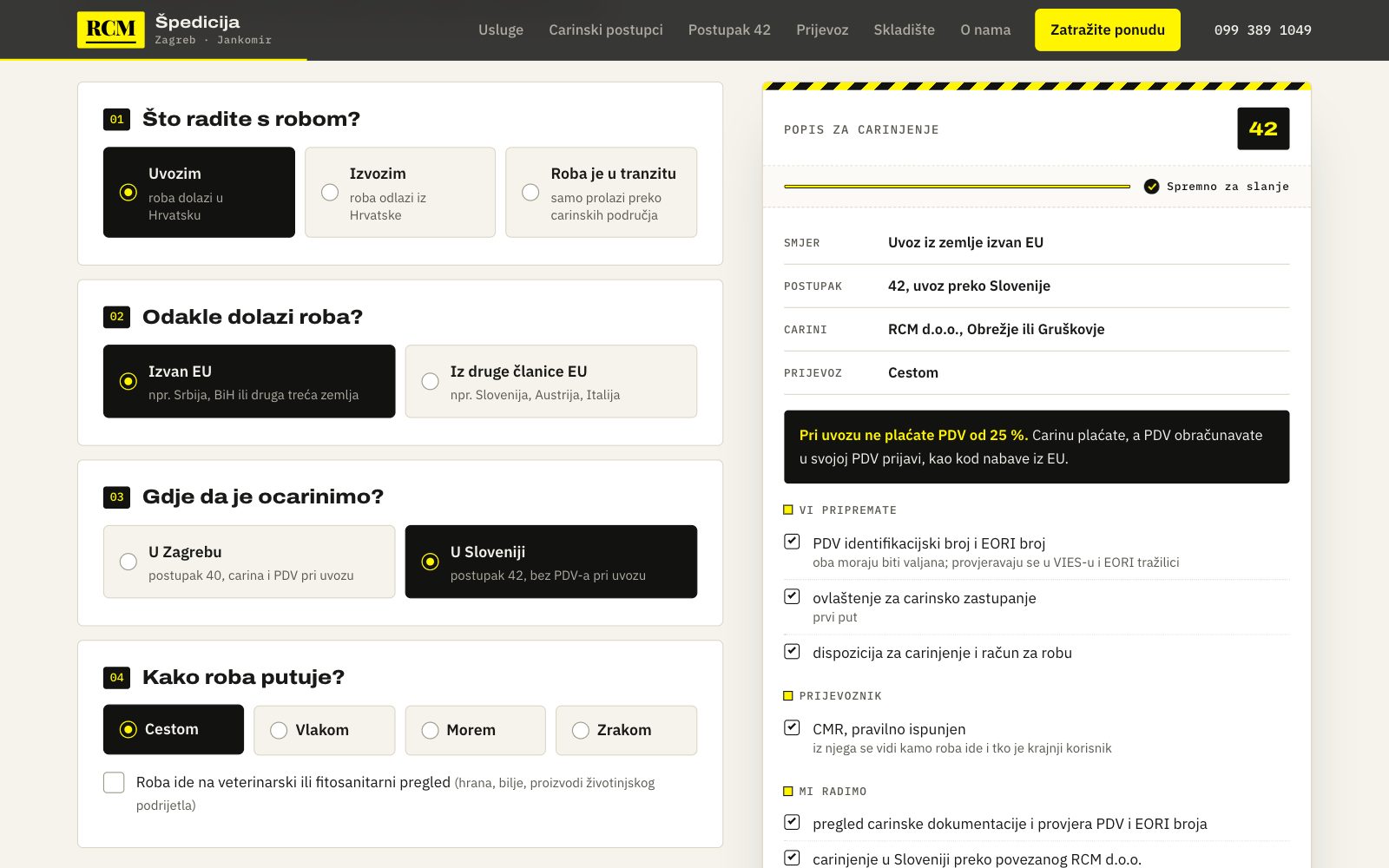
I turned their obligation lists into four questions: import, export or transit; where from or to; where to clear; how the goods travel. As the customer answers, a checklist builds in three groups, what you prepare, what the carrier brings and what the forwarder does, and a bar above it ends by saying the list is ready to send. One click copies the list into the contact form, which opens an email to info@spedicija.hr.
Black, yellow and the codes
Yellow and black come from their logo, with a warm grey. The codes customers use, 40, 42, T1, T2L, EUR.1, CMR and EORI, are set in a monospaced font, as on a document. On a phone the map sits under the headline, the route runs in two columns and the checklist builds below the questions.
How it's built
Static HTML, CSS and JavaScript with no framework. I generated the map as SVG from geographic data, and the routes draw in through masks. GSAP with ScrollTrigger runs the route of the goods, IntersectionObserver brings in the other sections and Lenis smooths scrolling. Hidden starting states are set only once JavaScript loads, so without it everything is visible and the route is a finished diagram; reduced motion turns animation off. There is no server: the browser builds the checklist and the enquiry goes out as a mailto link. The prototype is noindex, its JSON-LD holds only facts from their site, and photos are resized, with fixed dimensions and lazy loading.
What I would do next
I would first check whether the general checklist matches how they work, whether the office opens at 8 or 7, and whether RCM Špedicija holds AEO status itself or only its Slovenian sister company does. A real project would add a form that sends without the customer's email program, an English version like the current site's, redirects from old addresses and the downloadable documents, such as clearance instructions.