Fustis d.o.o.
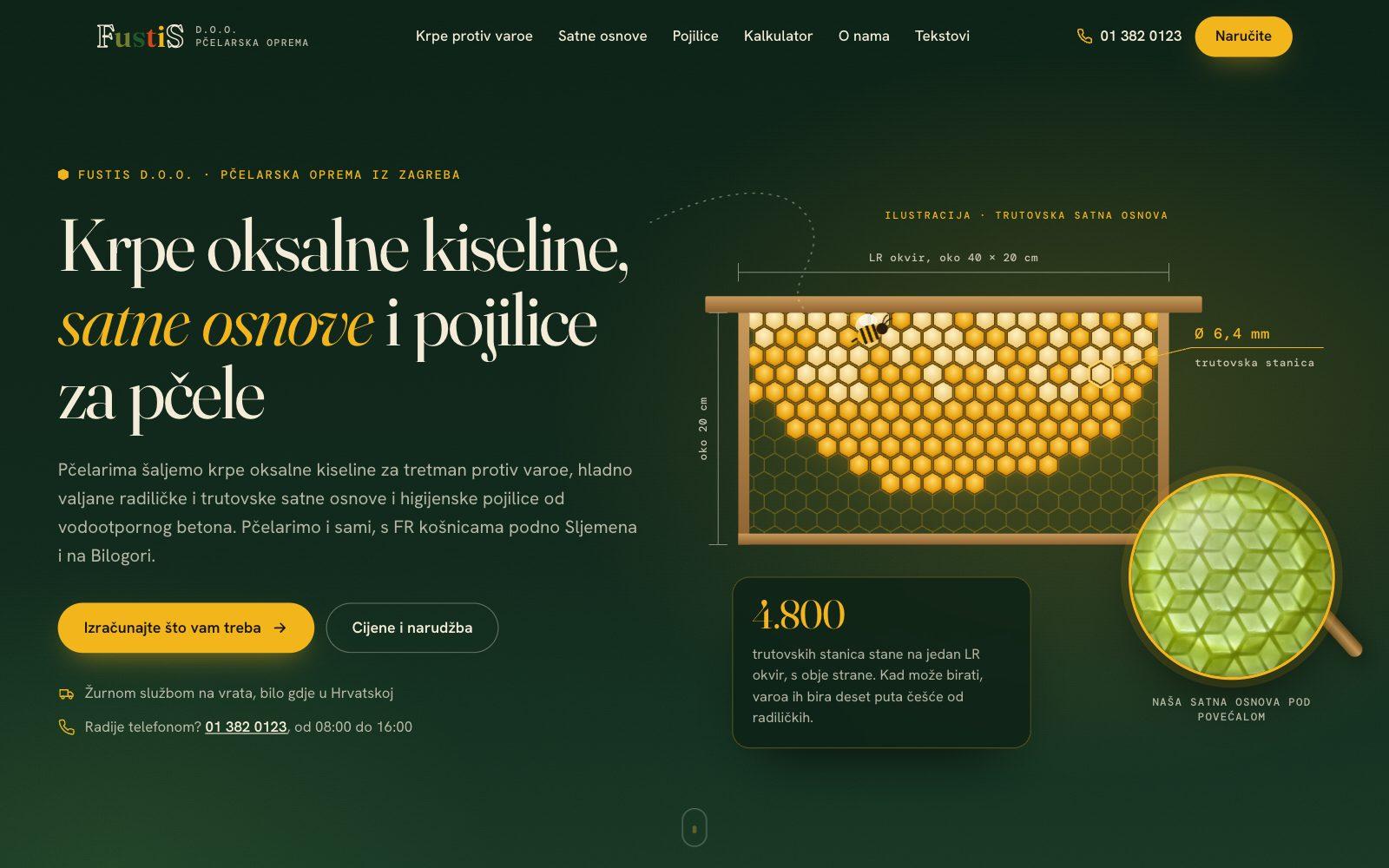
Open the conceptA concept website for a beekeeping supplier: prices on the home page, a drawing of how a drone frame pulls varroa out, and a calculator that builds the order.
Fustis d.o.o. is not my client and did not commission this website. I made the concept on my own initiative from the text and photos on their public website, so every fact on it is theirs.
- Page weight
- 3.36 MB → 0.52 MB
- Requests on load
- 26 → 25
- Main content on a phone
- 15.9 s → 0.8 s
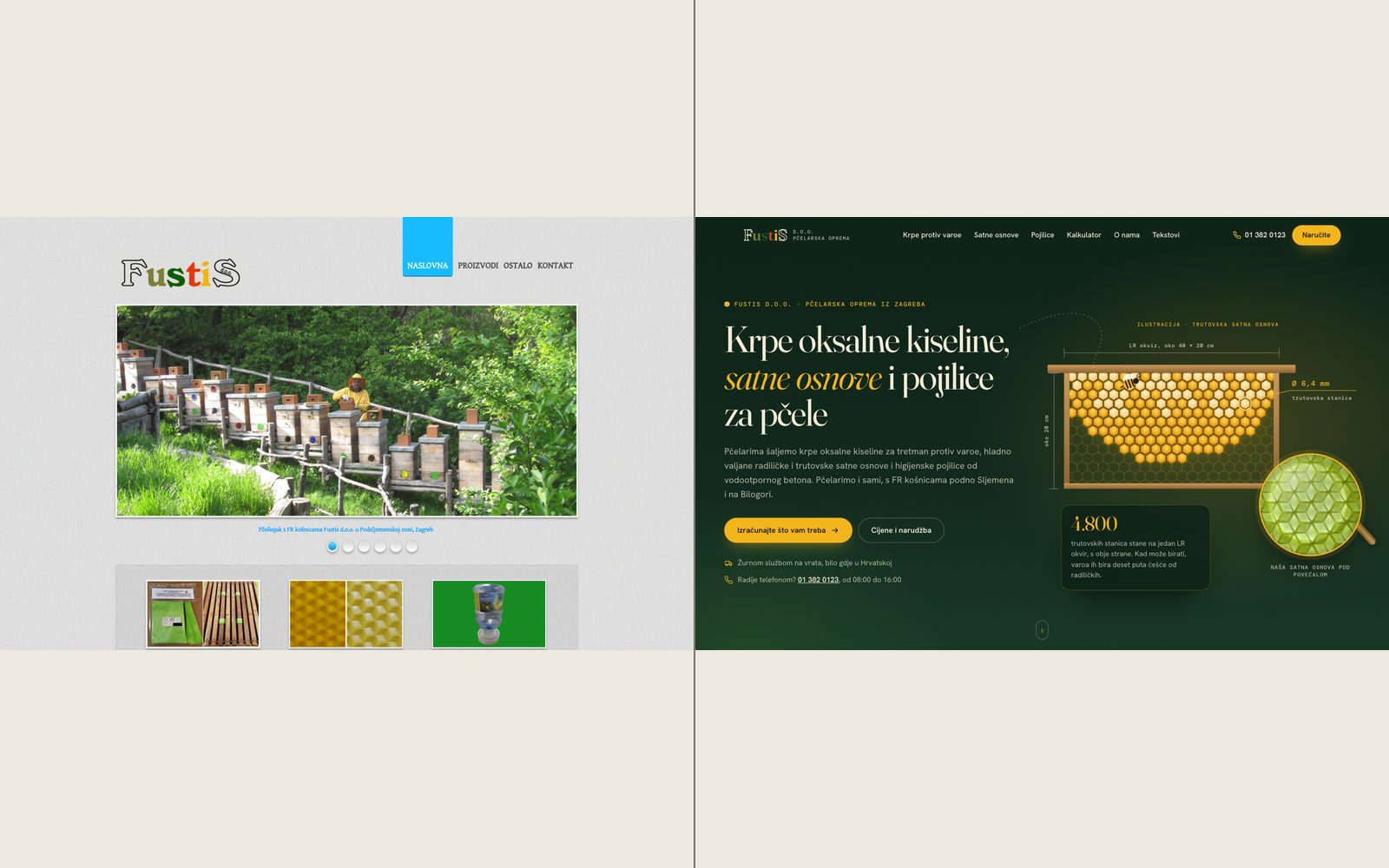
Measured in Chrome on 14 November 2026: phone, throttled 4G and CPU, no cache, median of three runs. Current website first, concept second.
- Company
- Fustis d.o.o.
- Service
- Concept website and order calculator
Fustis d.o.o. is a Zagreb company that supplies beekeepers with oxalic acid strips for varroa treatment, cold-rolled worker and drone comb foundation, and concrete hygienic water troughs. They keep bees themselves, with FR hives below Sljeme and in Bilogora. Their customers know the trade and ask: how much do I need, and when does it go in?
What I found
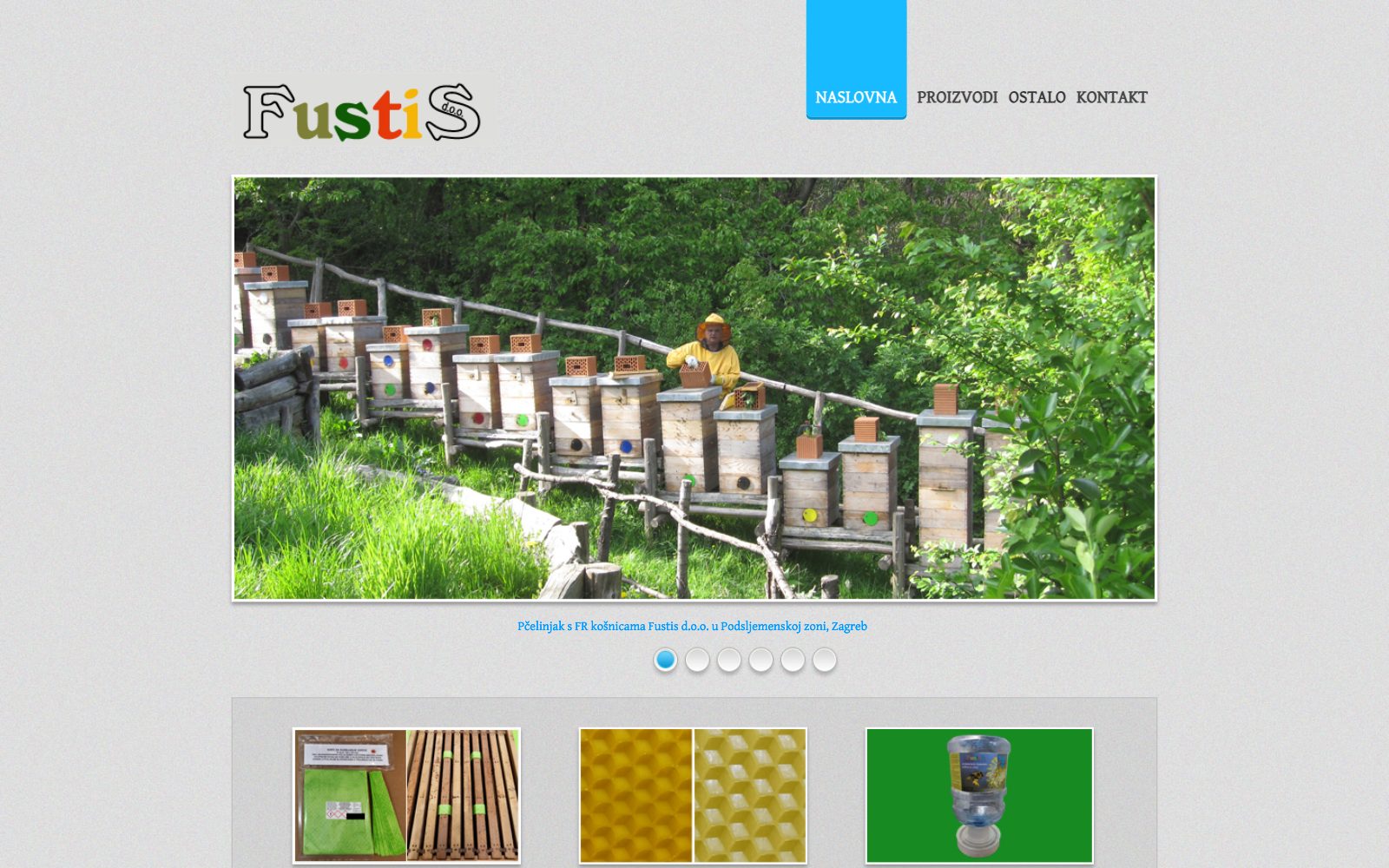
I went through the site on 14 November 2026, on a laptop and a phone.
- On a laptop, the first screen is logo, menu and an apiary photograph. Product headings start 896 px down, just below a 900 px screen, and the H1 is empty.
- Prices sit on a separate Products page, retail and trade. For comb foundation the price reads "____€ kg".
- There's no order form, and the phone number isn't a link on any page, so on a phone it has to be copied by hand.
- Five of their nine articles on varroa, wax and water return a 404 error, because the file name contains č or đ.
- On a phone, the site is 6 px wider than the screen, so it also scrolls sideways.
Decisions
Products in the headline, prices on the home page
The headline says only what they sell. Below it sit two buttons and courier delivery to the door, which today appears only beside the price list. Every product on the home page shows its retail and trade price, and comb foundation says "price on request" instead of a blank.
A drawing of the comb
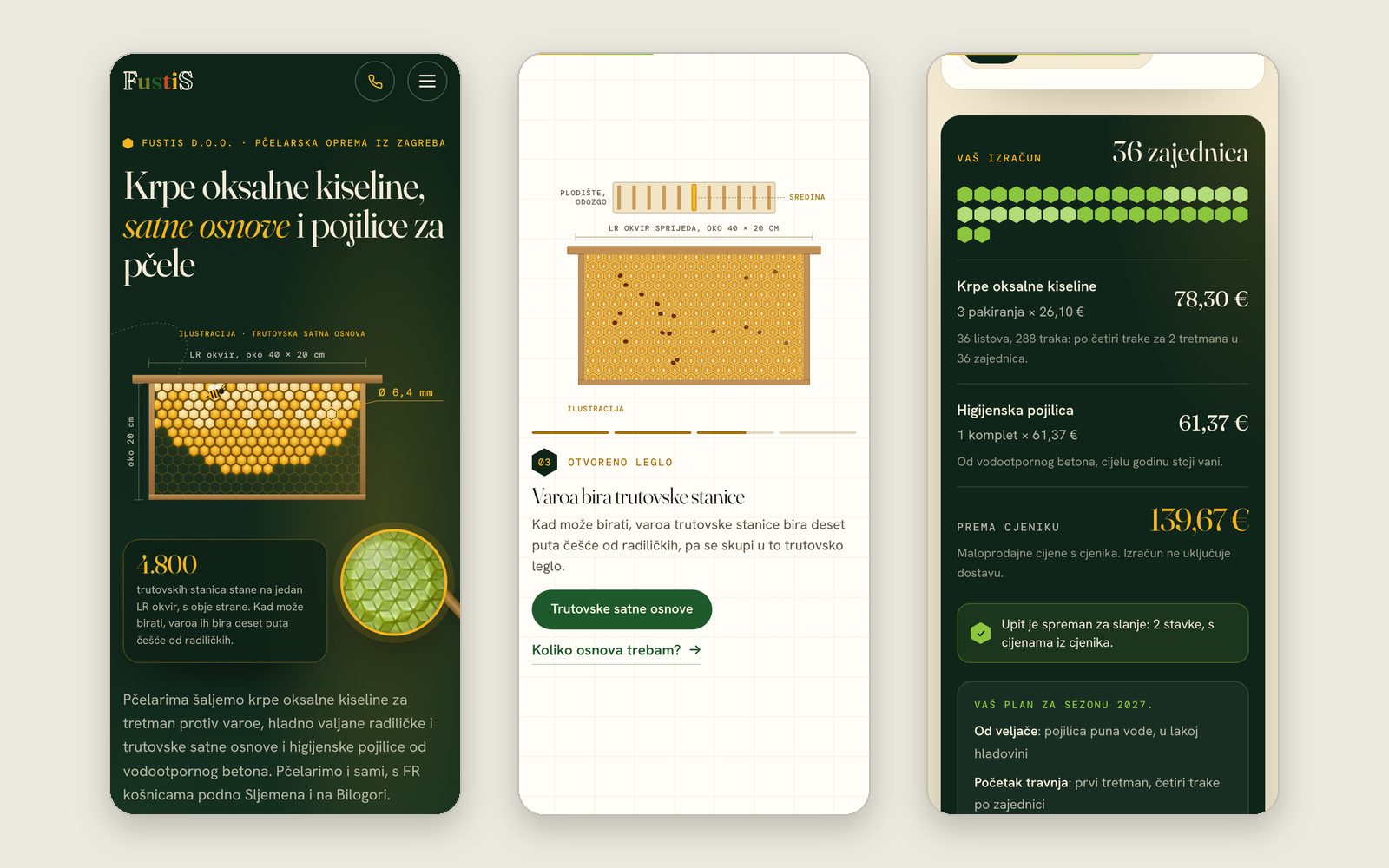
Next to the headline, an LR frame with drone foundation draws itself, dimensioned from their own article: roughly 40 × 20 cm, with a 6.4 mm cell. The comb fills once, a bee lands, and it stays still. The green and honey yellow come from their logo. Every drawing is labelled "Ilustracija" (illustration); the photographs are theirs.
The drone frame in four steps
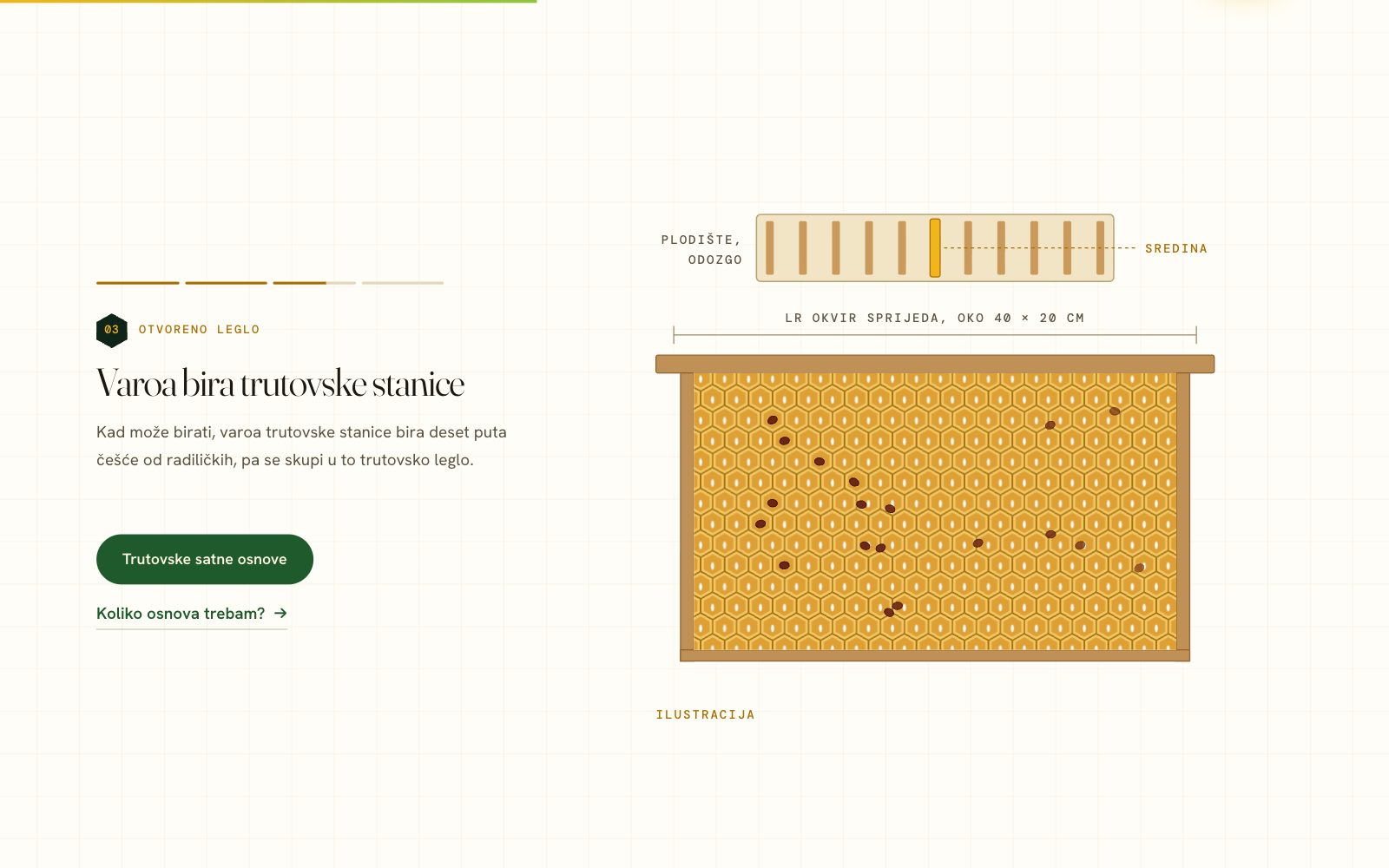
Their strongest argument, drone foundation as biological varroa control, was buried in a PDF. I turned it into a drawing that follows the scroll: the frame goes into the middle of the brood box, the colony draws it out and the queen lays, varroa moves into the drone cells, the brood is capped and the frame comes out. The wording follows their instructions, and a dial below shows month by month when the trough, strips and drone frame go in.
A calculator that builds the order
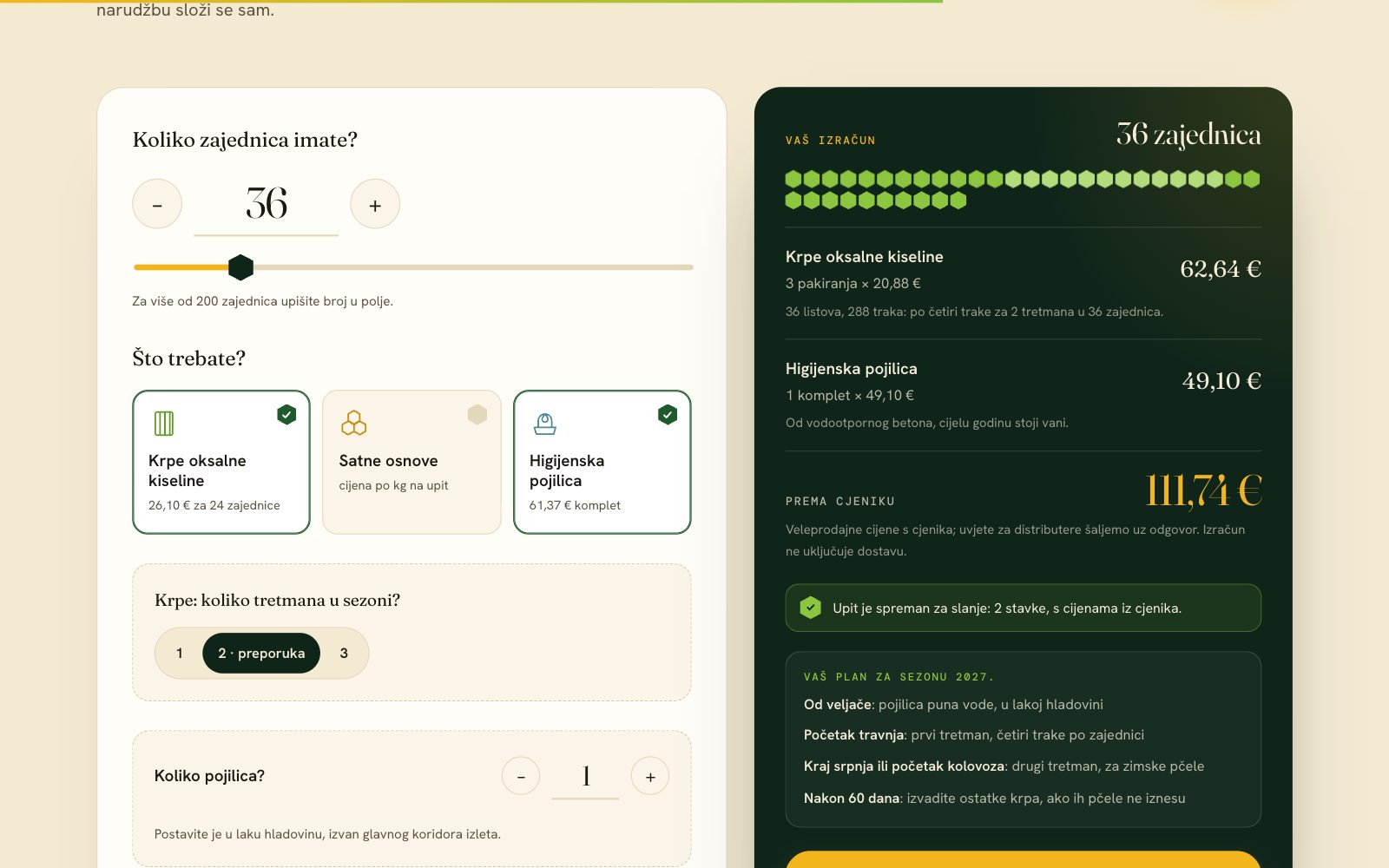
The beekeeper enters colonies, products, treatments and frame type, and orders as a beekeeper or as an association or shop. Using their instructions, it works out packs of strips, the price-list total and a treatment plan. Once a product is chosen it says the enquiry is ready, and one click copies it into the form, which sends it by email to info@fustis.hr.
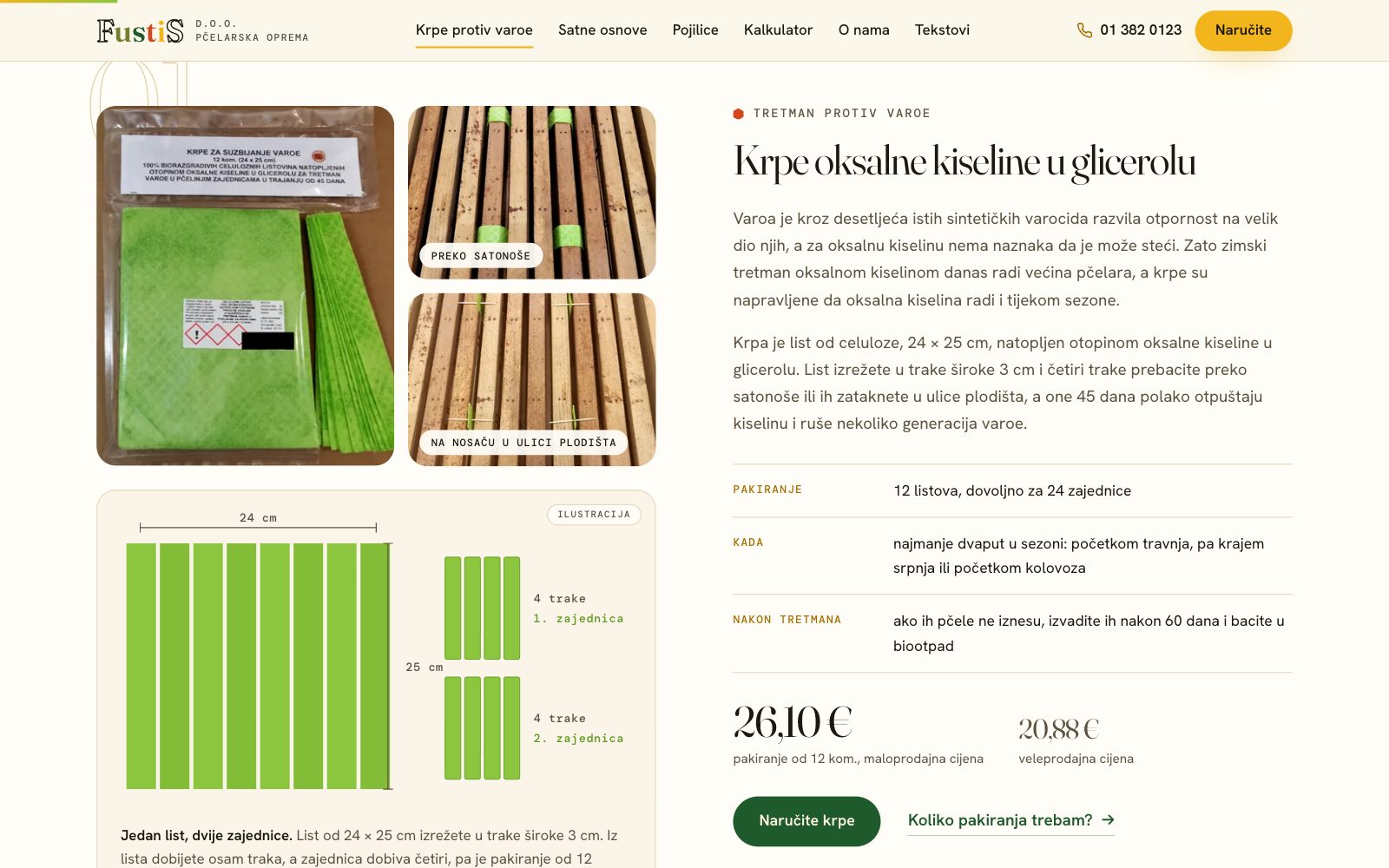
A drawing of one 24 × 25 cm sheet cut into eight strips shows why 12 sheets treat 24 colonies.
On a phone
The comb drawing sits under the headline, the drone frame story stays pinned with the drawing above the text, and the phone number is a link throughout.
How it's built
Static HTML, CSS and JavaScript, no framework. The drawings are SVG, with the comb generated by a script so the cells match. GSAP animates the first screen and sections, ScrollTrigger pins the drone frame story to the scroll, and Lenis smooths scrolling. Hidden starting states are set only once JavaScript loads, so without it everything is visible and the story becomes a list beside the finished drawing. Reduced motion turns animation off. The calculator and form need no server: the order opens as a ready-made email. All nine article links open. The page is noindex, the JSON-LD holds only their own data plus the Google Maps address, and photographs are WebP with fixed dimensions, loaded as they reach the screen.
What I would do next
I'd first ask the company which address is right (the site says Okrugljak 10, Google Maps Ulica Huga Badalića 26c), what foundation costs per kilo, and whether the trough guarantee is multi-year, as the site says, or lifetime, as one article says. A real project would add a form that sends without an email program, a page per product, and redirects from old addresses, including the five broken articles.