Drukkerij Verduyn
Open the conceptA concept for a family print shop near Roeselare: print jobs build up as a works order, and VAT receipt books and prescription pads show a price at once.
Drukkerij Verduyn is not my client and did not commission this website. I made the concept on my own initiative from the text and photos on their public website, so every fact on it is theirs.
- Company
- Drukkerij Verduyn
- Service
- Concept website and print order builder with prices
Drukkerij Verduyn is a family print shop in Rumbeke, just outside Roeselare, with more than a hundred years in the trade. They print for businesses, associations and private customers, plus VAT receipt books for restaurants, prescription pads for doctors and online A4 and A3 printing. Most customers come with two questions: what will it cost, and when can I have it?
What I found
Checked on 14 November 2026, on a laptop and a phone:
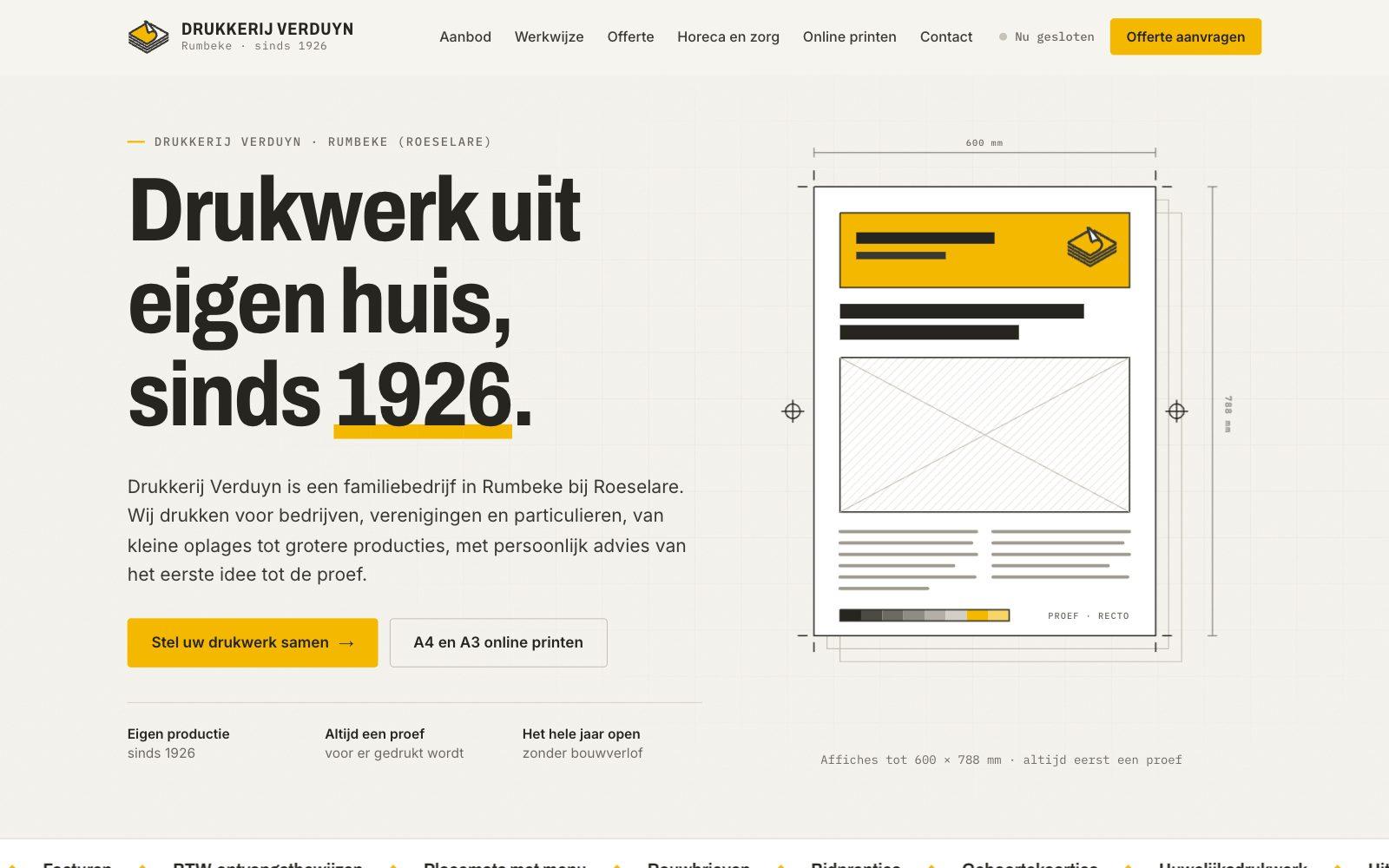
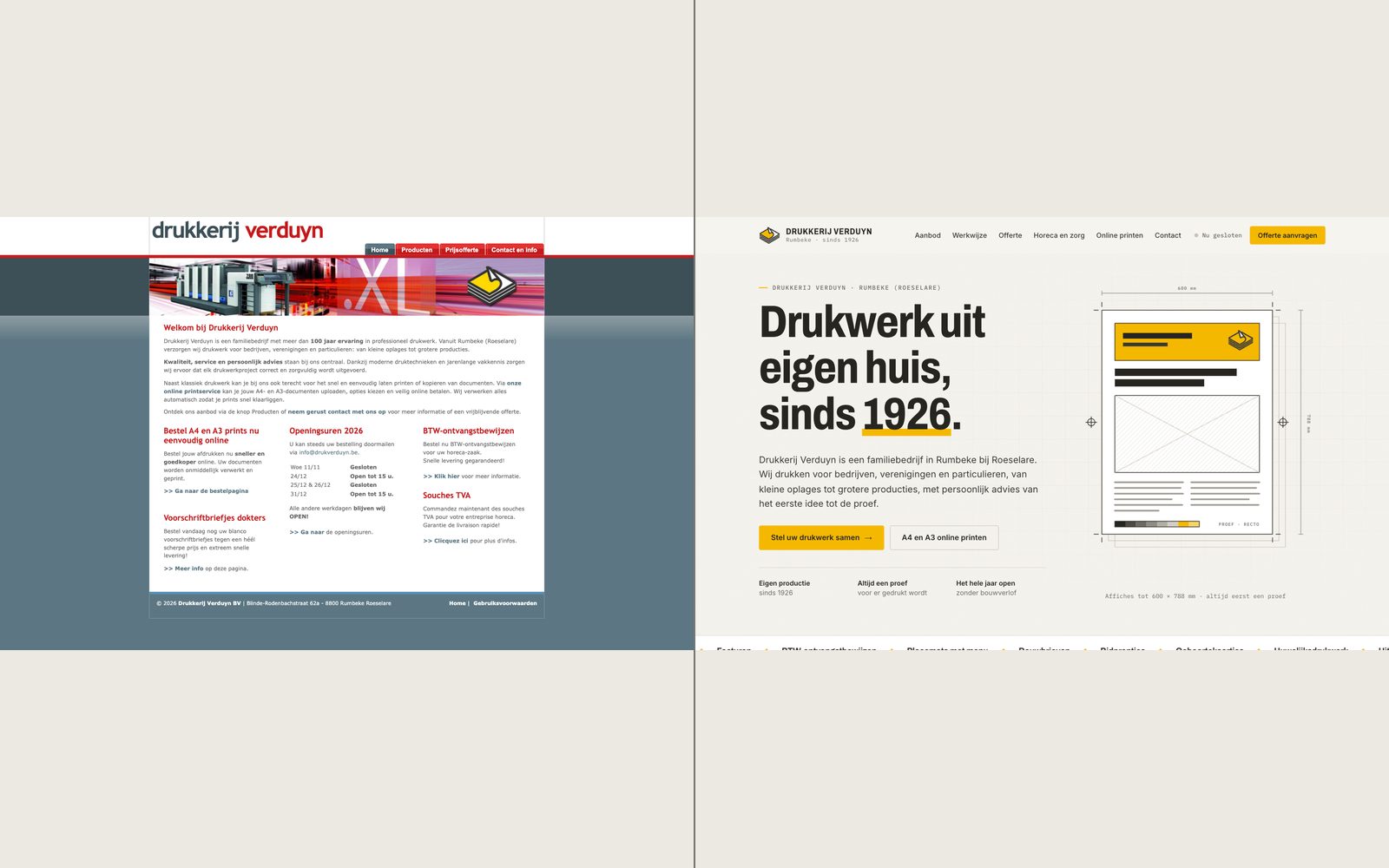
- The homepage, product pages and quote form have no mobile viewport tag, so a phone shows the 980 px desktop layout shrunk to 40 %, and 11 px text ends up under 5 px. Only the online printing section adapts to phones.
- Their strongest point, more than a hundred years of experience, sits in bold mid-paragraph. The homepage never mentions 1926; "Eigen productie sinds 1926" appears only on the online printing page.
- Prices for VAT receipt books and prescription pads are tables excluding VAT, with delivery in a separate block. The customer works out the total.
- The quote form asks for job type, paper, weight, run, sides, colours and artwork, then a security code copied from an image.
- Opening hours have their own page; the homepage lists only the holiday exceptions.
Decisions
The year and their own presses up front
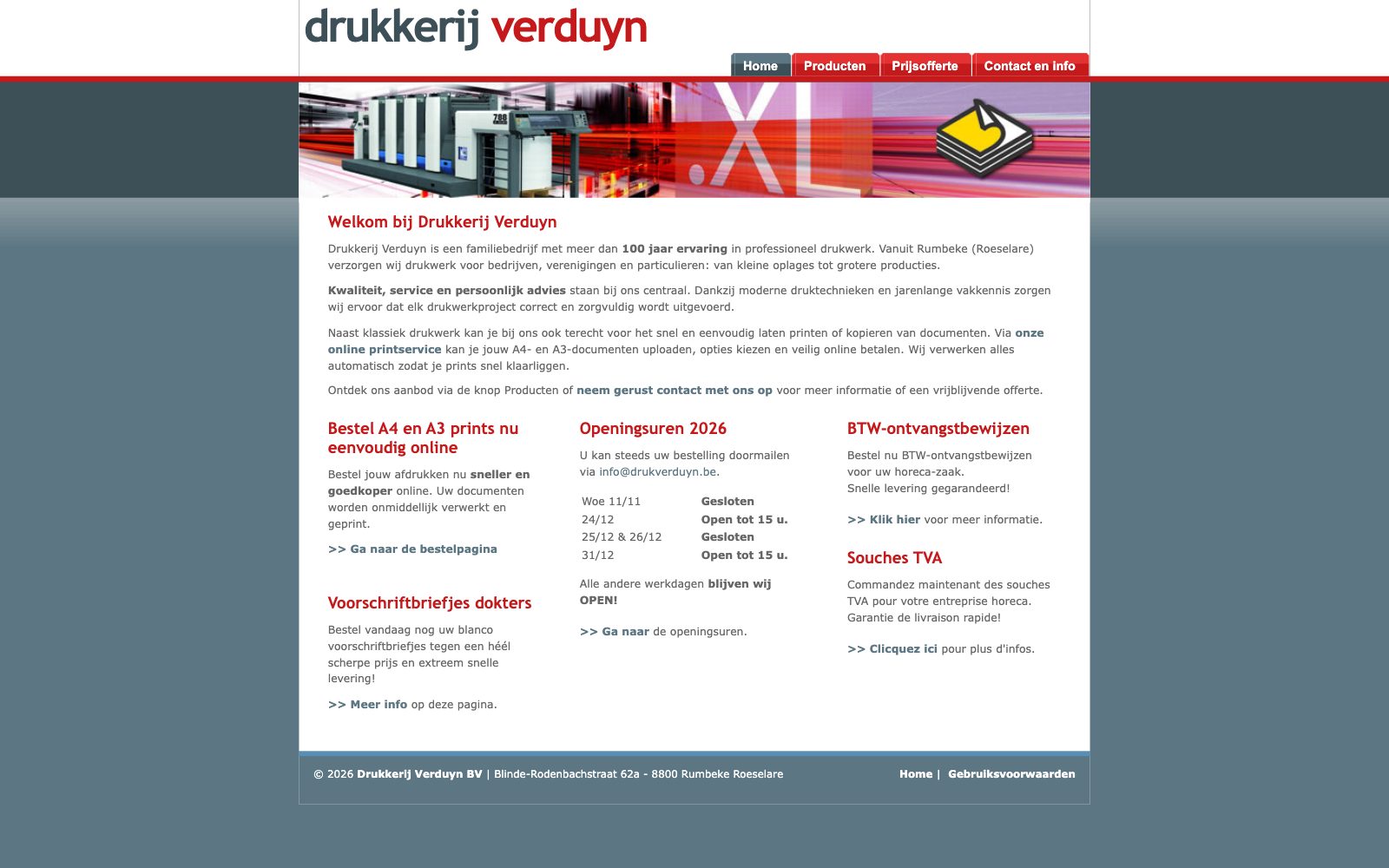
The headline grows out of their own line, "Eigen productie sinds 1926": "Drukwerk uit eigen huis, sinds 1926." Below it sit two buttons and three facts from their site: their own production, a proof every time, open all year. The header shows whether the shop is open right now, from their published hours and the 2026 exceptions.
A press sheet instead of a photograph
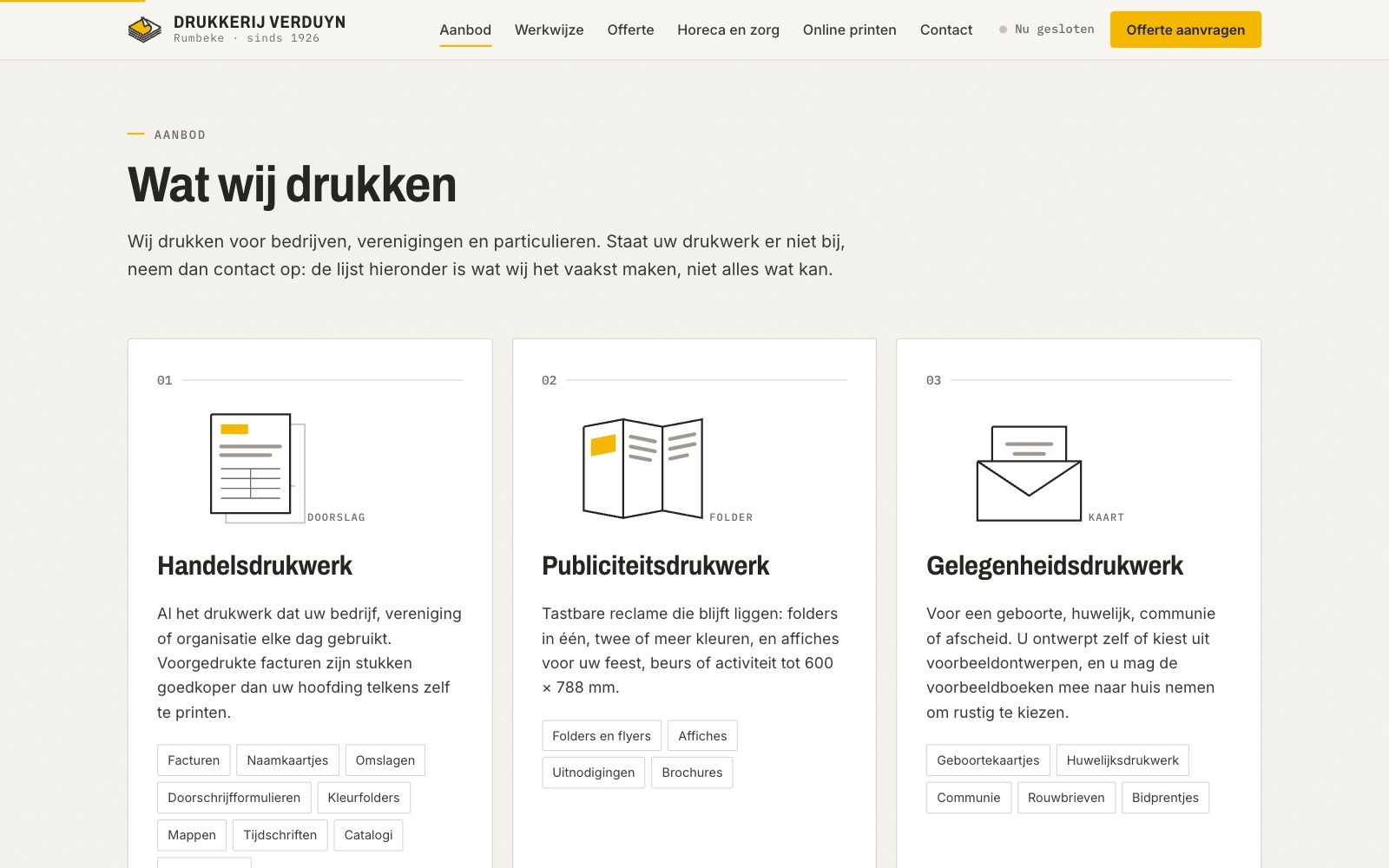
With no photographs from the shop, I used what a printer looks at all day: a 600 × 788 mm poster sheet, the largest size they list, with crop marks, registration marks and a colour bar. It draws itself once, a roller passes over and "prints" each block, and then it stays still. The yellow comes from their centenary mark, set against warm paper greys. Each product card has a small drawing of its own.
Four steps, one drawing
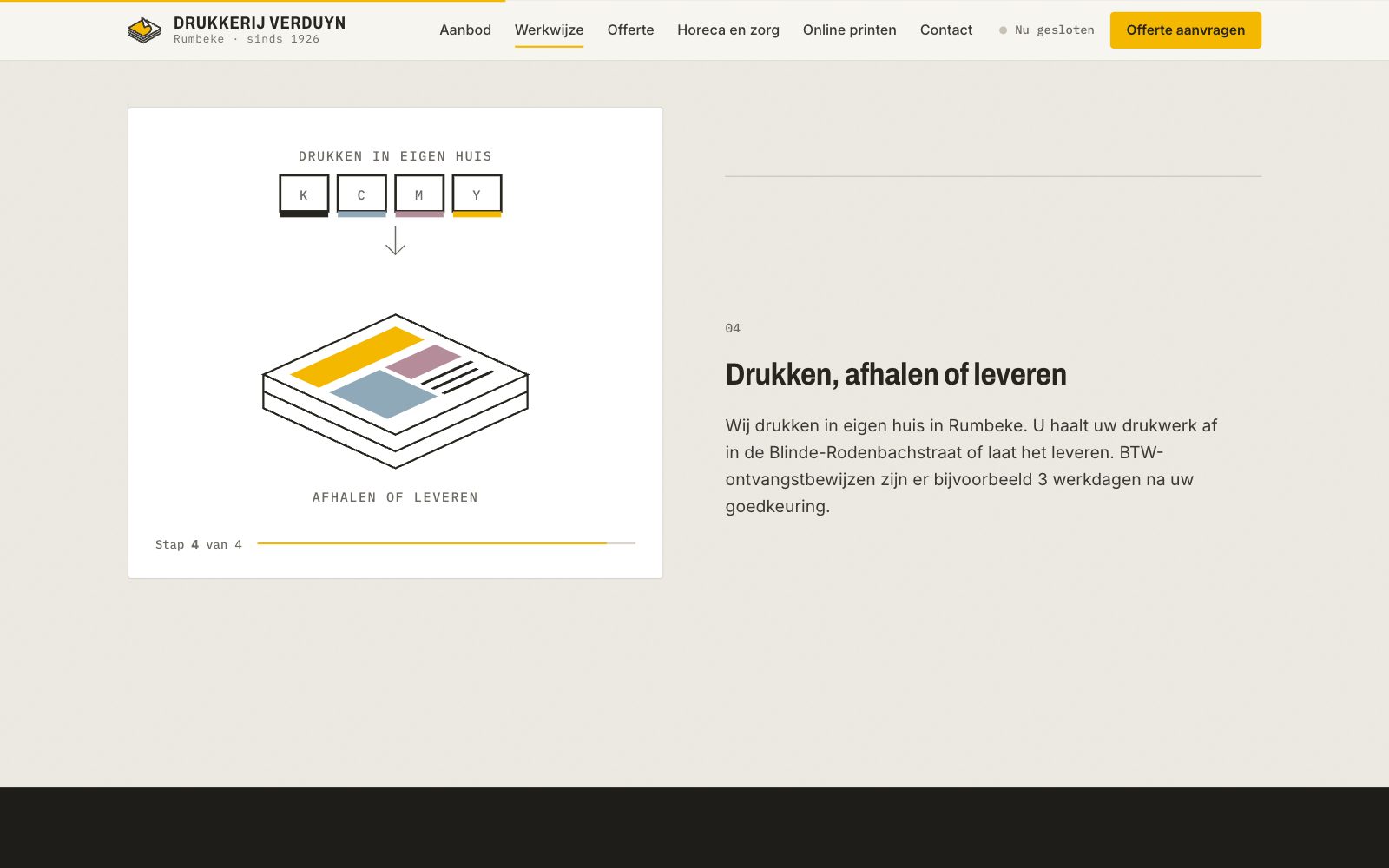
Their process has four steps: enquiry, artwork, proof and printing. I made it one drawing that follows the scroll: the enquiry fields fill in, the layout appears on the sheet, a "PROEF OK" stamp lands on the proof, and the sheet runs through four colours onto a stack for collection or delivery.
A works order instead of a form
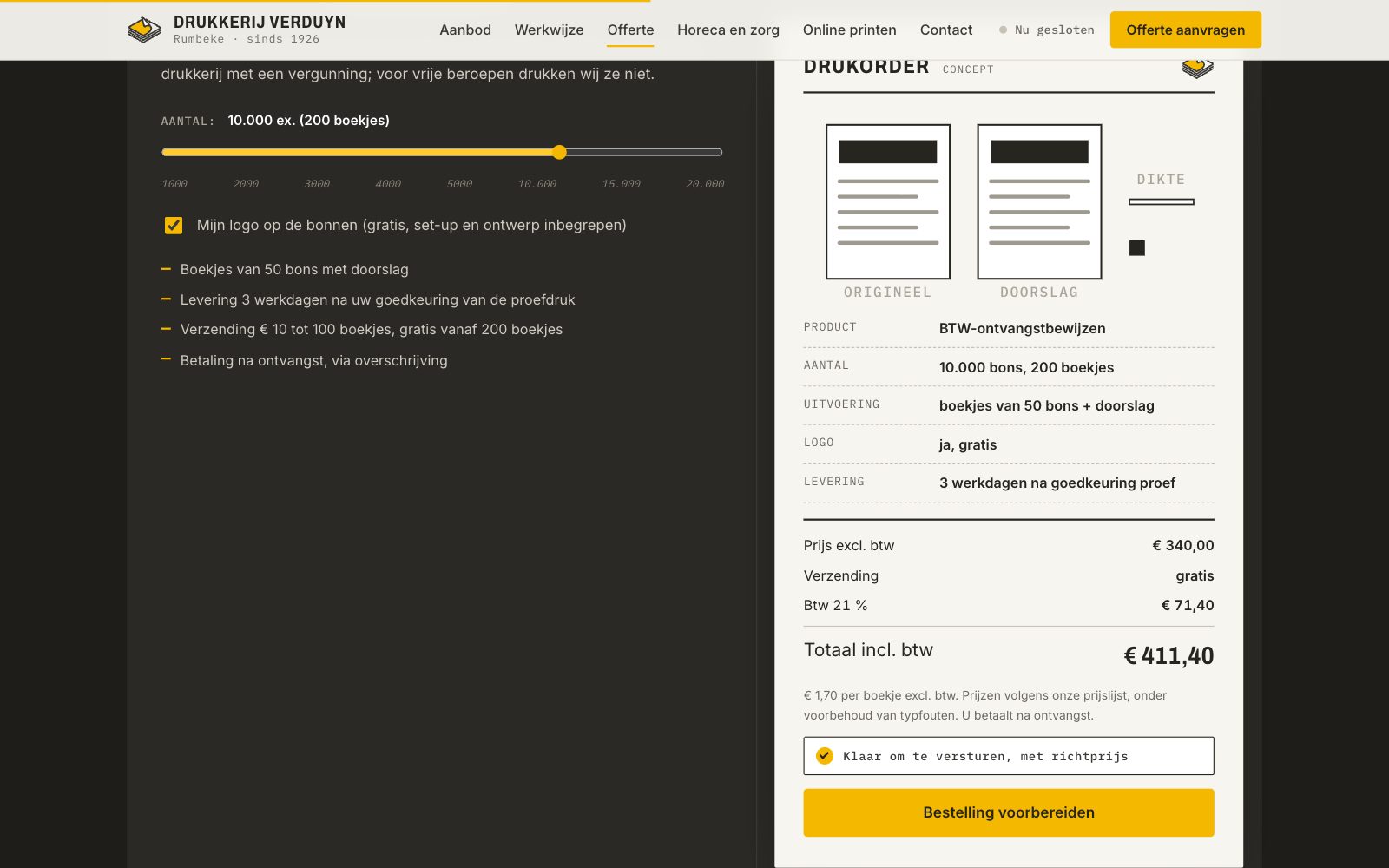
"Drukwerk op maat" uses the fields of their quote form and builds a works order with a drawing as the customer chooses: one side or two, paper thickness, number of inks. For VAT receipt books and prescription pads it prices the job from their own list, with delivery and 21 % VAT. When everything is in, it says the order is ready to send, and one click copies it into the contact form, from where it goes as an email to info@drukverduyn.be.
Phone and language
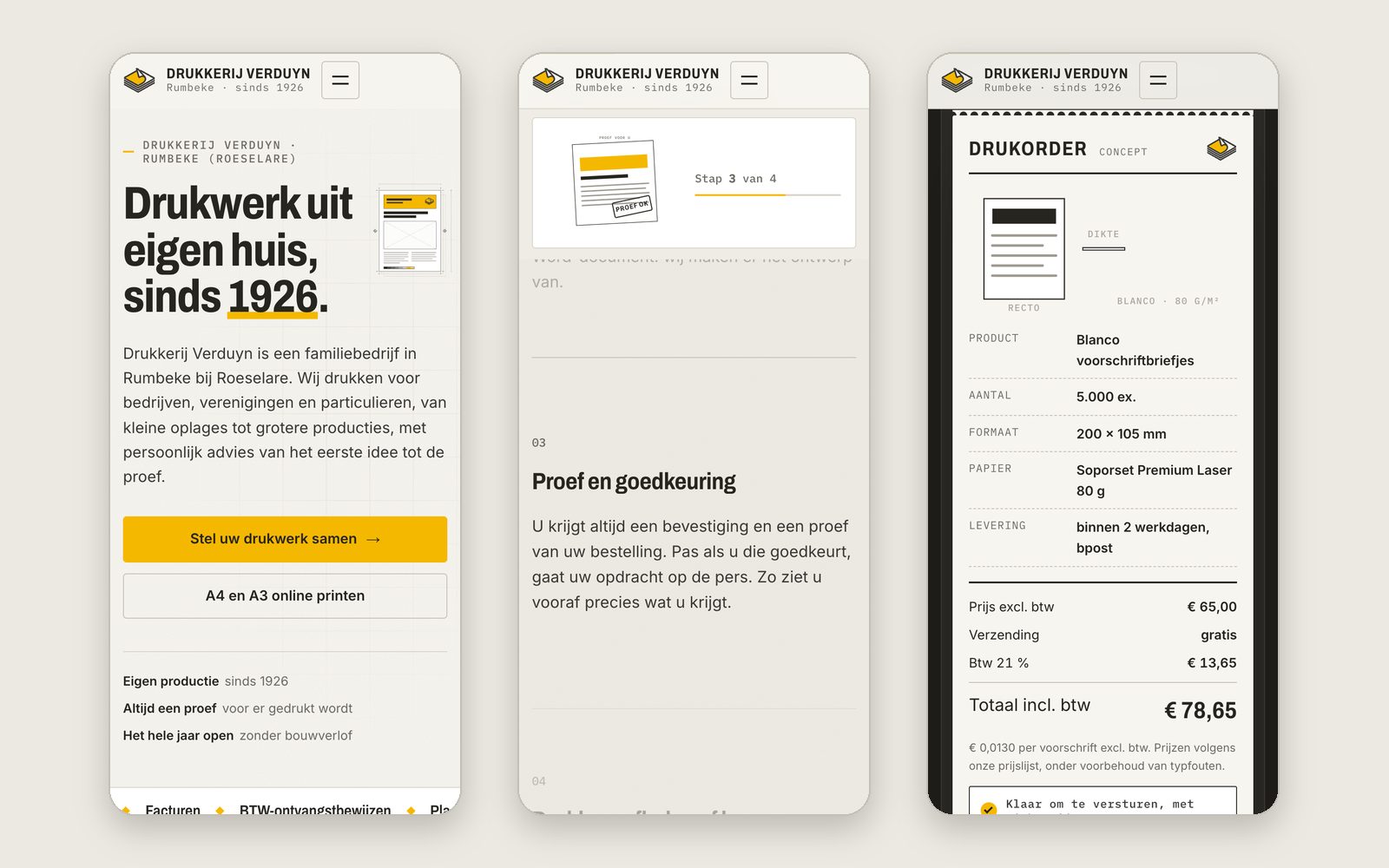
On a phone the sheet sits beside the headline and the process drawing stays at the top while the steps scroll beneath it. The site is in Dutch, like the current one, with the French line on VAT receipt books they already have.
How it's built
Static HTML, CSS and JavaScript with no framework, and hand-written SVG. The press sheet is drawn with CSS (stroke-dashoffset), sections come in with IntersectionObserver, and GSAP with ScrollTrigger runs the process drawing. Without JavaScript the page is fully visible, and reduced motion turns the movement off. There is no server: the browser works out the price, the enquiry leaves through mailto, and opening hours are checked against Brussels time. The prototype is noindex, its JSON-LD holds only data from their site, and images load as they reach the screen.
What I would do next
I would first check that the prices for VAT receipt books and prescription pads are current, and whether photographs of the shop and presses can go on the site. A real project would add a form that sends without the customer's email program and accepts files, the VAT receipt book order with logo upload they have today, and redirects from the old addresses.